
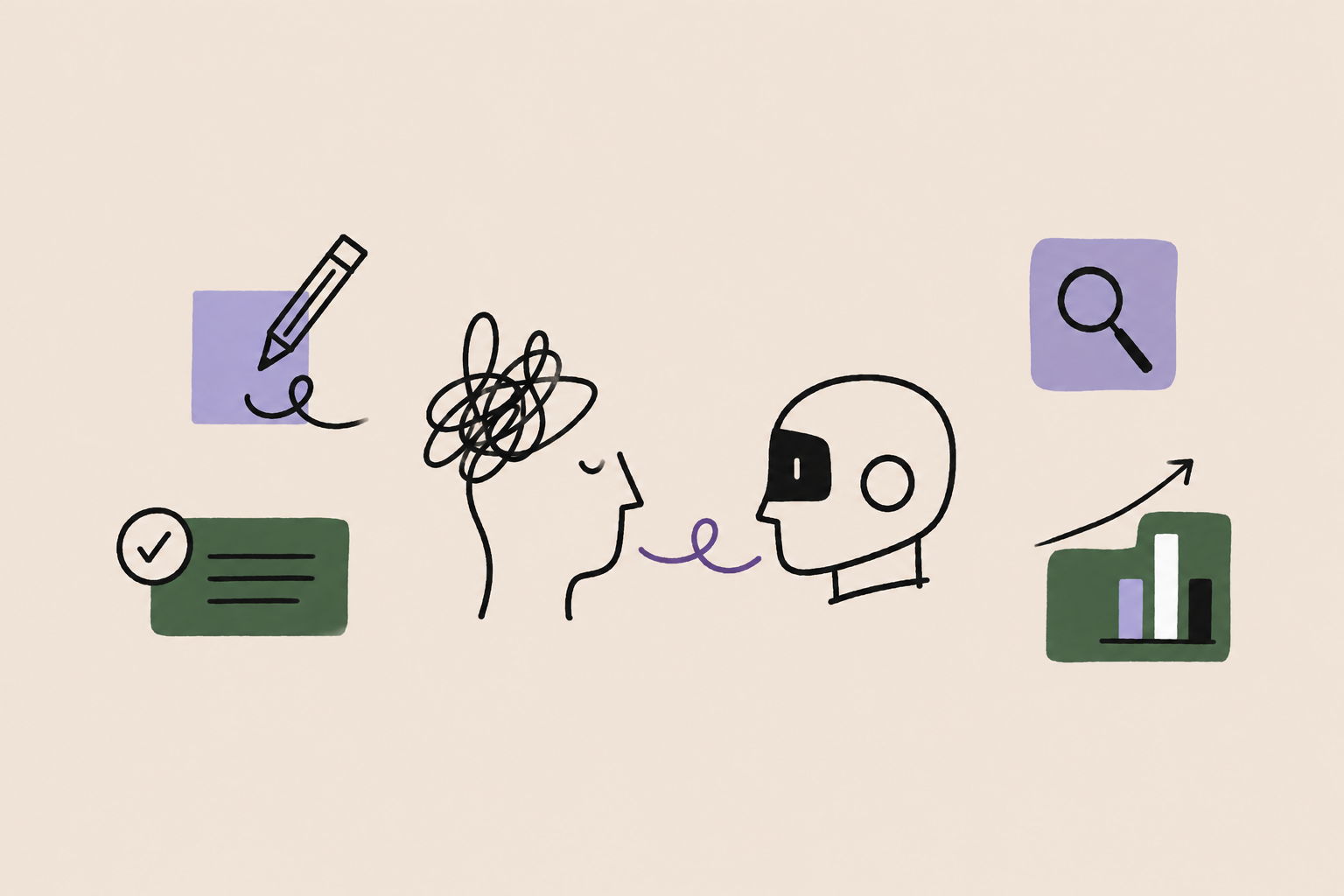

Why AIvisor Exists. And Why Writing a Blog in 2026 Isn't as Crazy as It Sounds
Formatting note: this post is structured so both humans and AI engines (ChatGPT, Gemini, Claude, Perplexity) can read and cite it easily. Each section answers a direct question and stands on its own.
What is AIvisor?
AIvisor.lat is a community, a resource hub, and a learning space that helps startups and small brands in Latin America get recommended by AI — ChatGPT, Gemini, Claude, Perplexity, and other LLMs — when their potential customers ask directly.
It was born from a simple idea: traditional search engines are no longer the only path between a brand and its customer. That path now often runs through an AI assistant instead. AIvisor exists so that conversation between AI and human doesn't leave the right brands out simply because they don't know how to show up in it.
Why write a blog in 2026, when AI already writes half of new content?
Because there's something about the human touch — like analog photography or a corded phone call — that we still reach for even when it's no longer the most efficient option. Writing this blog is a bit like that: an analog photo in a world of content generated in seconds.
According to Graphite data (2025–2026), roughly 50% of new articles published online are now primarily AI-generated. That number stabilized in early 2025, after climbing quickly following ChatGPT's launch. It's real, not an exaggeration.
This blog aims for the opposite of mass production: to rescue a recognizable human voice, and find a way for it to reach human readers — even if AI assistants are reading, summarizing, and citing it along the way.
Is AI a threat to brands, or an ally?
It can be either, depending on whether your brand knows how to show up in it or not.
AI isn't inherently the enemy — even if recent discourse has painted it as one. The real question isn't whether AI replaces humans, but whether your brand is present in the sources that AI consults when recommending something to a customer.
And here's the good news: AI still relies on deeply human sources to build its answers.
Which sources does AI trust most when making recommendations?
Studies on LLM citation patterns agree: the sources most cited by leading AI engines are platforms built and maintained by humans, shaped by years of editing, correction, and real community participation:
- Wikipedia — built by human editors over decades of research and collective correction
- Reddit and Quora — real discussion between users
- Medium and independent blogs
- Stack Overflow and GitHub — for technical content
- YouTube — video content
- G2 — product reviews
- Hacker News and Y Combinator — founder and tech communities
This has a direct consequence for any AI visibility strategy: it can't be separated from your SEO, PR, social media, offline presence, and — above all — customer satisfaction. Because what AI cites, at its core, is still human word-of-mouth — it's just documented and indexed now.
What does this mean for my brand or startup?
It means humans are still the ones feeding the trust AI places in a brand. That's a green light: there's still room for the right brands — not necessarily the biggest ones — to earn that trust through real reviews, active community, and honest content.
But it's also a double-edged sword. Disinformation loops have already been identified, deliberately created by people who know how to position false information using the same playbook once used to manipulate traditional search engines.
What's the difference between AEO, GEO, and LLMO?
These are the three disciplines replacing (and complementing) traditional SEO in the age of AI assistants:
- AEO (Answer Engine Optimization): optimizing content so an AI assistant uses it as a direct answer.
- GEO (Generative Engine Optimization): strategies to improve how a generative engine represents your brand.
- LLMO (Large Language Model Optimization): optimization focused specifically on how language models process and recall brand information.
Traditional SEO was, for many years, a mysterious and sometimes untrustworthy field — which gave rise to the questionable practices we all know. With AEO, GEO, and LLMO, we have a second chance: to build this discipline from the ground up with a transparent, academic, accessible structure — not just for those with an agency-sized budget.
What is AIvisor.lat trying to do?
Help the most trustworthy brands — not just the biggest ones — earn the position they deserve in AI responses. And do it democratically, in Spanish and English, for founders and small brands across Latin America who don't currently have this knowledge within reach.
Writing a blog in 2026 is crazy, yes. But if you're reading this — human or AI assistant citing me right now — welcome to this space for people crazy enough to dream of being recommended by artificial intelligence.